| |
Phillip Warnell is an inter-disciplinary artist producing work that is balanced between perception, event and documentation. Using the body as a sound orsource image, it is distinguished by its attention: todetail, to technique, to humour, to scrutiny, and to the complex relationship between live performance and the mediated image.
Phillip studied MA Fine Art at Chelsea College of Art & Design, London, In Paris at Cergy Pontoise Art School and at The Fine Art Academy in Prague. He has exhibited internationally since 1995, commencing with The Frequency of Resonance at L'Ecart, Paris with Thomas Hirshhorn, Boris Achour and Claude Leveque. Recent projects and exhibitions include at the Brakkegrond Arts Centre, Amsterdam (2007), Endo-Ecto, ICA, London (2006), Le Dojo, Nice (2006), Suture, The Old Operating Theatre, London (2006), Homo Futuris, Ghent (2006) and a three-person show with Fiona Crisp and Matthew Tickle at Matt's Gallery, London (2005).
He has undertaken residencies at Moly Sabata, France (2007), Asteride, Marseille (2006), the Visual Studies Workshop, Rochester, New York (2000) and Cite International des Arts, Paris (1998-2000), 'Charge', a live art residency at FirstSite, Colchester (1998) and received a British Council/Czech Govt Post-graduate scholarship in 1993/4. He lives and works in London and is currently artist in residence at Warwick University
Phillip presents a series of new moving image and photographic slide works at 300m3 Art Space that correlate with spectral, furtive forms of presence and encounter. In each, something, someone or somewhere is dealt with as if ‘taking place’, an event emerging through a resonant and transformative act. Disciplines and roles such as those defined within medicine, history and art merge in these hybridised exchanges. The fluidity of involvement and spatio-temporal correspondence they provide might best be described as the circumstances of event forming bodies; the convergence of appearances and environments as they are swept into mediated forms and recorded passages.
The Girl with X-Ray Eyes
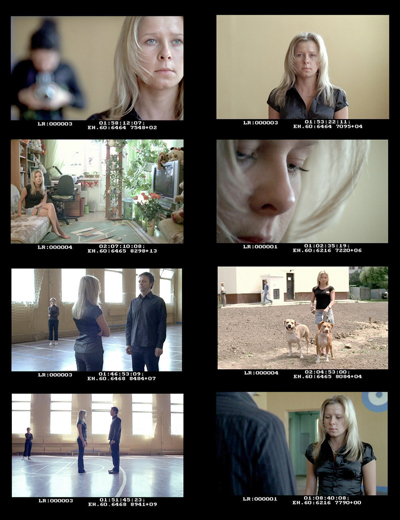
Natasha Demkina is known internationally as The Girl with X-ray Eyes. A Russian teenager and medical student, she is purported to have the ability to look directly inside bodies utilising a form of supplementary vision or second sight. In June 2007 Phillip Warnell went to Moscow and performed an encounter with Natasha, during which he offered up his own body as the subject for scrutiny before a series of witnesses. Introducing ideas on the negotiated use of filmic space, the project is concerned with the direct act of looking; how looking and seeing can indeed become a veritable act. Charting the process through which Natasha scans the body, producing a verbal report on her findings, the film also questions the role and status of the artist, drawing attention to ulterior motives and furtive, discreet forms of communication.
Completed in January 2008, the film is accompanied by a specially commissioned soundtrack by Russian composer Vladimir Nikolaev featuring the use of the Theremin, a non-contact Russian instrument, the history of which is intrinsically linked to that of espionage and immaterial phenomena, music from the ether. The film is complimented by a slide show of photographic material produced throughout the two-day shoot.
“The power of science produces a sort of reaction of subjects, an almost vital refusal to let ourselves be reduced into the algorithms of science. Phillip Warnells film about Natasha Demkina states that subjects cannot be comprehensively calculated”. Gérard Wajcman
Fever
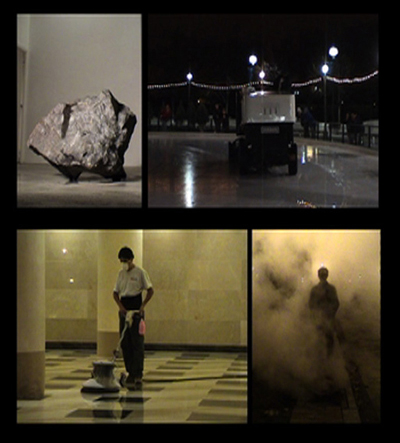
Filmed on location in Washington DC and Nice, Fever features a waterstone, an icerink, a steam outlet and some floor polishing. Highlighting structurally linked ideas concerned with transformative, metonymic properties, screen choreography and the coverage of materials - their flow and temperature - the piece considers the associative relationship between work, absorption and performance.
Placebo
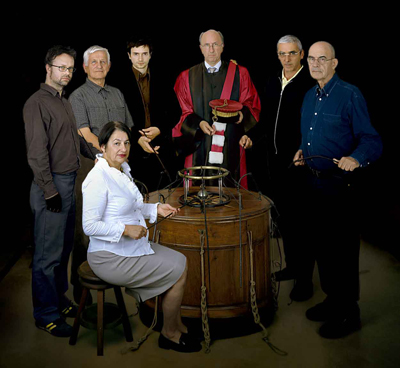
Franz Mesmers sole surviving baquet is one of the most extraordinary objects ever conceived and manufactured. Intended to facilitate a group therapeutic circumstance, the baquets eight skeletal arms were designed to restore the bodies balance of animal magnetism: the strange, ubiquitous and invisible fluid Mesmer conceived of that supposedly connected all living matter in the universe – everything that could breathe or had a soul. Inlaid with Masonic symbols and intricate marquetry, the baquet evokes notions of secret societies, altered states, the traumatic encounter, coded knowledge and hypnotic intensity. For his spectral group portrait Phillip Warnell has chosen an assemblage of seven figures from distinct yet interconnected professions who collectively surround the object performatively, providing a personage and continuity to the ideas envisioned by Mesmer in 18th century France.
www.phillipwarnell.com |
|
 |