
Past exhibitions |
2009 | 2008 | 2007 | 2006 | 2005 | 2004 | ||
 |
|
| 2009 | |||
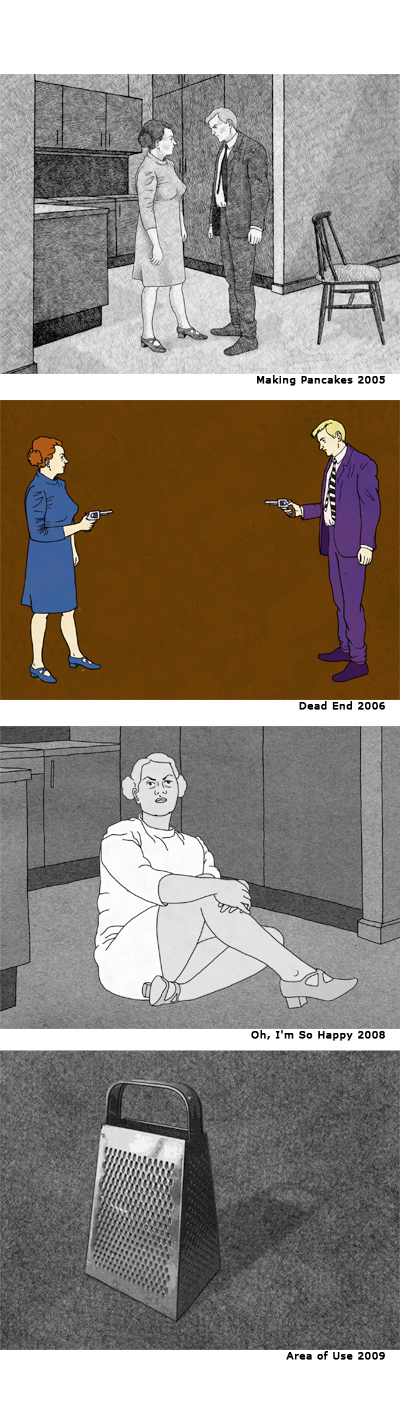
Cecilia Lundqvist (Sweden) 2009-01-16 − 2009-02-08 Installations with animated video works Cecilia Lundqvist, b. 1971 in Eskilstuna, Sweden. Works and lives in Nacka, Stockholm. Artistic education: The exhibition at 300m3 shows four short animations made during the years 2005-2009: Making Pancakes (2005), Dead End (2006), Oh, I'm So Happy (2008) and Area of Use (2009). 300m3 are also showing four drawings made in 2008: I Feel Protected Inside, I Sometimes Dream of a Very Different Life, There Is Nothing More and You Know What's Coming Next. Cecilia Lundqvist started as a painter, but changed to work with animation as a way of artistic expression in 1994. Her fascination for animation revolves mainly around the fact that it gives her the ultimate way of expressing - telling and drawing in time. She often works with power structures and feministic issues. Her videos are personal, but in a distant way, perhaps due to the fact that they are animations and not live film. Cecilia Lundqvist has exhibited widely at art museums, institutions and galleries in Sweden and around the world. Her animations are often showed in screenings and film festivals.
Making Pancakes 2005 "Making Pancakes" is an animated video, showing a woman and a man in a totally unbalanced relationship. At times we see a seemingly everyday course of events, and other times they are in a more threatening situation. The man is filled with self-satisfaction and yet he shines from an uncertainty and a longing for acknowledgement. The woman acts in a numb and routine way, doing all she can to uphold the façade. By changing the standard and placing the domestic violence outdoors, where it’s visible, and the upholding of the perfect façade hidden behind the closed doors of the home, the absurdity of this behavior is revealed. The trivial mistakes while making dinner serve as the catalyst of the violent outrages. Dead End 2006 The video “Dead End” is an animated illustration of a completely locked situation, without a chance of finding the solution. The imagery in the video is quite static and is primarily created to turn the focus to the dialogue. The two characters in the video, a woman and a man, act as eachother's opposites, both ready for the fight. Even though there is a clear dialogue between the two parts, they are unable to communicate. Of course, this creates no winner, but the result is rather two powerless losers. “Dead End” works as a reflection of the society in which we live today. Oh, I'm So Happy 2008 "Oh, I'm So Happy" is an animated video where we meet a middle-aged woman who is living in total isolation, with an extreme loneliness as a result. The woman performs a monologue, in which she tries her best to convince us about how happy and content she is with her present situation. However, her attempt is totally shallow and transparent. Area of Use 2009 The video "Area of Use" is an illustration of a housewife's inner thoughts about alternative ways of using her most common working tools. It is also a manifestation of a sealed existence that exposes a mind which gives a sense of being trapped in a treadmill. This work is closely related to the video "Oh, I'm So Happy". Four drawings: I Feel Protected Inside The four drawings form a short series of thoughts which are extracted from the video "Oh, I'm So Happy". The main intension with the drawings is to amplify the sense of this happening in more than one place. "The animations by Cecilia Lundqvist, of a very simple dramaturgy, a planar and clean drawing, present routine activities, using elements from the everyday life in order to point to some of the main problems in human relationships. By opposing mostly only two elements, in a binary system the author juxtaposes some examples of extremes, stereotyped relations or behavioural patterns: good and evil, male and female, body and soul. The reduced dynamics and monotony of the plot, as well as the tendency to repeat, merge with strong colours, mainly primary, while the sound points to the technological metamediatic origin of the realized idea. The treatment of sound (and voice, the spoken word) and its relation towards the video image is an important aesthetic element. The popular culture, mass media, film and pop art represent an important referential place in the works of this artist. The appropriation and recycling are for Cecilia Lundqvist important artistic strategies, like key words to the interpretation of her works and her creative and cognitive process. We often come across the strategy of appropriation, which exploits Hollywood. In that way Hollywood narratives are remodelled, revisited, adapted and shown in form of critical or cynical pastiches." Welcome www.geocities.com/cecilia_lundqvist/
|
 |
||
| Read review | |||
300m3 Art Space: Cecilia Lundqvist I Cecilia Lundqvists utställning på 300m3 möter Fredrik Svensk den antagligen mest sofistikerade återvändsgränd han hittills sett. Varför dödar vi inte varandra oftare? I London för ett antal år sedan - det var i samband med upproret i Paris förorter - kom jag att föra ett längre samtal med en äldre gentleman om skillnaden mellan fransk och brittisk kolonialism, och dess relation till skillnaden mellan samtida fransk och brittisk så kallad integrationspolitik. Dead End är namnet på det bästa verket i den utmärkt psykodramatiska separatutställningen"and we all reach Dead End sometimes" med Cecilia Lundqvist på 300m3. Verket är en projicerad animation som visar en man och en kvinna i profil stående mot varandra. De har var sin pistol i handen. Dialogen tycks mixad från film eller radio. Den är upphackad och snudd på obegriplig, men med en väldigt brittisk intonation. Fredrik Svensk |
|||